




The U.S. Food and Drug Administration (FDA) has requested changes to the warnings in hormone therapy labeling and has approved updated labeling for the first products. Learn what changed, who benefits most, and what to ask your health care provider.
What changed in 2025 and 2026?
In November 2025, the FDA requested the removal of risk statements about heart disease, breast cancer, and probable dementia from the boxed warning in hormone therapy labeling.
In February 2026, the FDA approved drug labeling changes for six hormone replacement therapy products. Specifically, statements related to cardiovascular disease, breast cancer, and probable dementia were removed from the "boxed warning," FDA's most prominent safety-related warning. The labeling still describes heart disease and breast cancer risks in other sections.
The boxed warning about endometrial cancer (cancer of the lining of the uterus) remains on whole-body estrogen-only products.
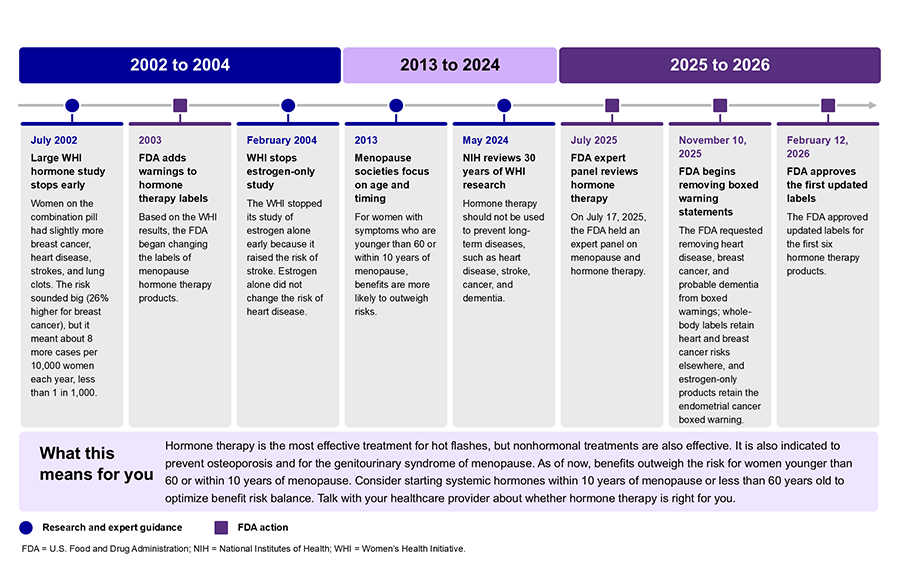
Why was there a boxed warning and why was it removed?
Two large Women's Health Initiative (WHI) studies stopped early in 2002 and 2004. They found more breast cancer with estrogen plus progestin and more stroke with estrogen alone. Two other WHI studies, in women aged 65 to 79, found more probable dementia.
Based on the conclusions from these studies, the FDA began approving labeling changes in 2003 that added warnings to hormone therapy products. These warnings later became the boxed warning, the FDA's highest-level safety warning.
WHI participants averaged 63 years old. Hot flashes usually start between ages 45 and 55. Some groups questioned whether the WHI results applied to younger women, and some women with symptoms did not take hormone therapy because of the warnings.
In addition, the WHI studies tested one type of estrogen pill (conjugated equine estrogens) and one progestin (medroxyprogesterone acetate). Other hormone therapies are available and used today, such as estradiol and micronized progesterone, and there are other ways of taking them, such as patches and gels.
The FDA reviewed newer WHI analyses and long-term follow-up data. In November 2025, the FDA requested that drug makers remove the heart disease, breast cancer, and probable dementia statements from the boxed warning.
Who benefits most from hormone therapy?
Benefits are more likely to outweigh risks for women who start hormone therapy before age 60 or within 10 years of menopause. Talk with your provider about your benefits and risks.
Hormone therapy relieves hot flashes, night sweats, vaginal dryness, and painful sex. It also helps prevent bone loss. Talk with your provider about your benefits and risks.
What is hormone therapy not for?
Hormone therapy treats symptoms and helps prevent osteoporosis. It should not be taken just to prevent heart disease. Experts do not yet know if hormone therapy prevents dementia.
What affects your risk?
Your risks depend on your health history, and the type, dose, and form of hormone therapy you use. Talk with your provider about which option is right for you.
Who should not use hormone therapy?
Hormone therapy is usually not recommended if you have:
- Unexplained vaginal bleeding
- Hormone receptor-positive breast cancer
- A current or recent blood clot, stroke, or heart attack
- Liver disease
Other conditions, such as a past blood clot or gallbladder disease, may affect which type of hormone therapy is right for you. Talk with your provider.
What should you ask your health care provider?
- Which of my symptoms can hormone therapy treat?
- Is hormone therapy safe for me, given my age and health history?
- Which type of hormone therapy, and which way of taking it, is best for me?
- How long will I need to be on hormone therapy? How often should my hormone treatment be reviewed?
- Are there other treatments that can help my symptoms?